

Best Books on Building a Small Home
A short, hand-picked shelf for the owner-builder, with notes on tools, materials, and building for yourself. Looking for websites instead? See our best web resource links.
As an Amazon Associate, CountryPlans earns from qualifying purchases made through the links on this page, at no extra cost to you. We only list books we genuinely recommend.
Building & Framing
The nuts-and-bolts of putting a house together.
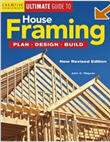
House Framing
“Probably the best framing guide available for standard wood frame construction.”
Much information and very clear graphics for the new builder. Includes tools, safety equipment, basic engineering concepts, choosing hardware and all the essential framing techniques. Covers framing of walls, floors, roofs (gable, hip, shed, gambrel), dormers, stairs and even a bay window.
If you could only read one book and you wanted to learn enough to build a simple house, this is the one to get.
View on Amazon ›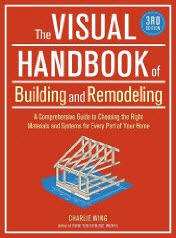
Visual Handbook of Building and Remodeling
Charlie (Dr. Charles G.) Wing is perhaps the most credible house building teacher in the world. Co-founder of the first owner-builder school (The Shelter Institute) his writing and teaching make complex issues understandable and buildable. With crystal-clear illustrations and explanations, this thick book (now in the 3rd edition) will become your encyclopedia of house building. Covers all aspects of building including electrical and plumbing, heating & cooling, insulation, drywall, tile work, trim out, and cabinets.
As a physics professor Wing has some great information on the building science of how houses work. His old 1976 book (From the Ground Up) was where I was finally able to understand the basic engineering of how forces go through a building. Check out your library to find his earlier books, all of which are great and packed with good information. Wing's body of work is the history of the owner-builder movement.
If you can get a second book on home building this would be my suggestion. Much more detailed than the great Wagner book above, you will continue to go back to this reference for years to come.
View on Amazon ›
Working Alone: Tips & Techniques for Solo Building
A step-by-step book for solving many of those tricky questions most new builders face. The author gives us practical solutions you won't find in even the best carpentry books. He uses simple jigs, clamps and brackets to build safely and accurately and without requiring an extra pair of hands. You continually say “why didn't I think of that?” Includes procedures for leveling and laying out foundations, framing steep pitched roofs, building overhangs and much more. Learn how to use measuring sticks in place of floppy tape measures, hoist heavy beams overhead all by yourself. You get the idea.
Read this book before you finalize your tool list. Carroll uses inexpensive tools that he modifies slightly to be much more valuable to the solo builder or the small building crew.
My third suggestion for a building book. This isn't the first book to read, but it's invaluable for the (soon-to-be) wise owner-builder.
View on Amazon ›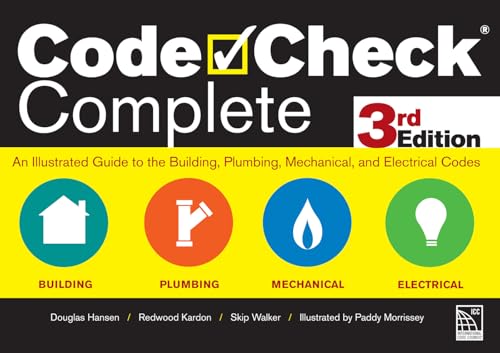
Code Check Complete (3rd Edition)
This is not a traditional book: it has tabbed, laminated lay-flat pages meant to be pulled out on the job and checked often. The Complete edition folds Code Check's separate building, plumbing, mechanical and electrical guides into one, keyed to the current model codes (the 2021 IRC and its companion codes, plus the 2020 NEC). It condenses the relevant sections and clarifies them with plain language and very clear diagrams. Think of it as the antidote to the brain-deadening full code books it is based on.
Code Check was devised by Redwood Kardon, a former electrician and building inspector who kept getting asked for his “cheat sheets.” The illustrations do a lot of the work. One caution that has only gotten truer over the years: locally adopted codes vary and are updated often, so always confirm the versions, amendments and rulings in force where you are building.
View on Amazon ›Design & Inspiration
The books that change how you see a home.
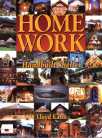
Home Work: Handbuilt Shelter
This book is a sequel to Kahn's 1973 book Shelter. A large oversized book with some 1,100 photos and over 300 drawings, it is difficult to put down. Some of the best photography you will ever see illustrates shelter from around the world, all built by hand and generally without outside professional help. This book will give you a window into vernacular architecture, not the kind that comes in a box, but the kinds of homes and buildings people make using materials they find around them.
The rest of the world knows about this type of building and much of it has evolved over hundreds of years or more. There are modern examples as well: hippy vans, naked builders, Flying Concrete, ferrocement houses, natural houses, unnatural houses, earth houses, boat houses, tree houses, fantasy houses, a greenhouse built out of old car windshields.
More great houses and buildings than you could ever imagine, simply because many of these places are beyond imagination. Be forewarned, there are things in this book that are guaranteed to inspire you to do something weird just because they are so interesting looking.
If you are looking for inspiration and want to get away from the cookie-cutter look, I highly recommend that you get this book. You won't be sorry. Order directly from the Shelter Publications store, or from Amazon.
PS: Kahn's later book is Builders of the Pacific Coast. And here is Lloyd Kahn's blog.
View on Amazon ›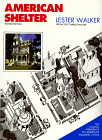
American Shelter
Les Walker is a great teacher. You'll find you're looking at American history with a fresh viewpoint when you see it through the evolution of what we've built to live in. Through the use of simple but very understandable line drawings, this book lets you mentally build and then walk inside most of the house ideas that have been tried on this continent. You start with a Native American wigwam, hogan, or plank house, then move on to the colonial settlers and see them build their first houses with pit-sawn timbers and thatched roofs, techniques they brought with them from the old world.
Later wood frame construction with machine-cut lumber allowed greater freedom and led to many great period styles as American wealth increased. The same type of drawings explain the evolution and construction of later house building techniques and styles including sod, strawbale, mobile homes, modular homes, domes, yurts and houseboats.
View on Amazon ›
A Pattern Language
It looks like a bible. It reads like a bible. It is a bible!
Almost any architect or designer with any vision at all seems more than a little upset that God didn't turn the whole project over to them in the first place. It may take you more than six days, but here's the outline to show you how to redesign everything from the social structure of Western civilization to the trim around your window.
The book is divided into 253 patterns. Each pattern describes a problem which occurs over and over again in our environment. It goes on to provide an essential core of a solution to that problem in such a way that you can use the same concept many times over without ever doing it the same way twice.
There's something timeless about this book. It seems to distill the humaneness from the designing and building process and give it to us in straight shots. This type of thinking transcends style but can form a foundation for the development of your own natural style.
View on Amazon ›Finding Land
Before the house comes the place to put it.
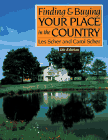
Finding and Buying Your Place in the Country
This book was initially self-published in 1974 by a real estate lawyer who moved to northern California to build a homestead. The book was about what he was learning from his own experience and those of his neighbors. My first-edition copy shows a picture of a skinny, hippy-looking fellow and his flower-child girlfriend. The latest (4th edition) shows a picture of a somewhat paunchy lawyer with a matronly wife and their two teenage daughters. Everyone's still smiling and they're still on the homestead.
Scher has continued to learn (now mostly from readers who write in with their stories) and continually updates his book. It will be invaluable in researching and purchasing property in your chosen locale. Like any good lawyer, Scher helps you review the pitfalls and potential problems of land purchase. This is a good resource for working with agents and owners, and a real book about real experience. If you will be buying property, let this be your first investment in the process.
View on Amazon ›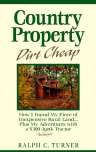
Country Property, Dirt Cheap
Turner is a frugal computer nerd with a love of solitude and tractors. Set in southern Iowa, this first-person story tells how he studied plat books looking for odd pieces of land, drove miles and miles of back roads, went to local farm auctions, and learned many new words like quitclaim and warranty deed. Finally, a “land wanted” ad in a local paper brought him to a fine 15-acre parcel of woods, with rural water, power and a small pole barn for $6,000 (1995 dollars). He then bought and moved an old 10' x 14' “summer kitchen” onto the land and used this as a sleeping cabin. His rural dream retreat was complete when he bought a 40-year-old farm tractor for $300.
A charming quick read, this book is well written and entertaining while being a practical workbook at the same time. Turner's property-search methods are well explained and could be used to find comparable properties in almost any rural community.
View on Amazon ›Barns & Outbuildings
Start small, build your skills.
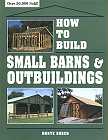
How to Build Small Barns & Outbuildings
This book has a lot more to it than just barns and outbuildings. You can use it to build a hen house, root cellar or woodshed and get some basic building skills in hand. Then, when you are ready, the book will help you lay out several other stick-frame, post-and-beam and pole-barn type structures. The drawings are clear, the photos are from real buildings, and the how-to-build information is timeless. Because it covers several specific building projects rather than generic building situations, you feel like you learn more and are more ready to build. Some of the buildings have nearly complete plans included.
This inexpensive resource is also a good guide to low-cost construction. Just good country building: solid, but without fluff and gingerbread.
View on Amazon ›CountryPlans is a participant in the Amazon Services LLC Associates Program.