

Spacers help keep siding dry and ventilated
John Raabe on how the strips go on, and what builders on the forum report about the weather barrier underneath.
In wet cold climates such as New England, Canada and the upper Midwest, moisture can saturate wood sidings and cause mold, mildew and rot when the siding is not able to dry out.
NOTE: While not unknown, this is not as likely to be as big a problem with metal, plastic and cement board sidings as they will not hold as much moisture as wood.
The key to drying out the siding in such climates is to ventilate the backside of the siding. This is sometimes called “providing a drainage plane” and is normally done by stapling thin strips of wood or plastic over the top of the building paper (or Tyvek type housewrap) and then nailing the siding through these strips. A typical thickness of 1/4" is sufficient to back ventilate the siding.
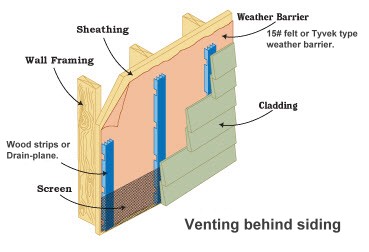
In the diagram above I have modified the Drain-plane diagram to cover the more general solution. Drain-plane is a high-quality commercial product meant to solve this problem.
[Side note concerning the weather barrier under the vent strips: Builders and owner-builders on the CountryPlans forum who installed wood sidings have reported better long-term service from regular 15# building felt (tar paper) than the newer plastic housewraps.]
For more information on the forces at work and a history of such problems when an existing house was retrofitted with insulation in the walls please visit this article: https://www.buildingscience.com/documents/insights/bsi-028-energy-flow-across-enclosures.
Where to go from here
- Read thinking like water, John’s wider piece on keeping a wall dry.
- See how to work with your building inspector.
- Browse the rest of the CountryPlans library.
- Ask what siding and weather barrier builders in your climate are using in our discussion forum.