

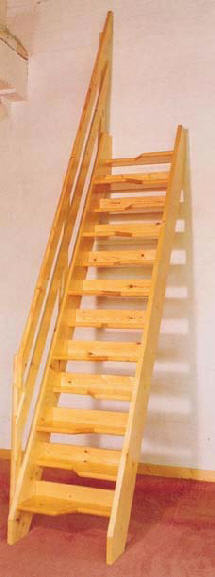
Alternating tread stair design
Also called a ladder stair, a Jefferson stair or a loft stair.
Adjust the riser height to the space between floors. For a 9’ floor to floor height there would be 14 risers of 7.714”. Start with this and adjust the angle of the carriage from there.


I think I would add a non-slip surface material to the step portion of the tread.
The sizes on the sketch
Every size below is written on the drawing above. Your building department has the final say on all of them.
| Part | Size on the sketch |
|---|---|
| Sides and treads | clear 2x12 or LVL lumber |
| Risers for a 9’ floor to floor height | 14 at 7.714” |
| Max rise (R) | 8” |
| Run (T) | 10 to 11” |
| Clear width inside | 24” minimum |
| Hand rail | 34” above the nose |
| Nose | 1½” |
| Kickplate | 1x4 |
| Tread attachment | full height 1x notched in the 2x12 |
| Tread screws | countersink 3” to 3½”, cap with buttons |
| Floor space out to the wall | 4’-9” (will vary) |
On the tread detail: 10” to 11¼” front to back, 24” to 28” across, with “adjust for nose” marked at one end.
(sketch problem 6-8-04)
This type of stair saves lots of space and can have standard rise and run dimensions to meet code. However, it is quite steep and a bit scary to go down head first (most people turn around, like you would on a ladder). Some building codes will allow this type of stair into lofts of 250 sf or smaller. Here are some suggestions about how to build this type of design. It is sometimes called a Jefferson stair as Thomas Jefferson was an early promoter of the space efficient design.
I hope this gives you some useful ideas. John Raabe, www.countryplans.com. For a better printing PDF file click HERE
Where to go from here
- Print or save the PDF of this sketch, which prints better than the page.
- Read how building codes and permits actually work with stock plans.
- Ask about stairs in our discussion forum.